How to Attach a Tracker to a Dog Harness Safely
Attach a GPS tracker to your dog's harness without snags, slipping or pressure points: where it goes, what to avoid, and a two-finger fit check.
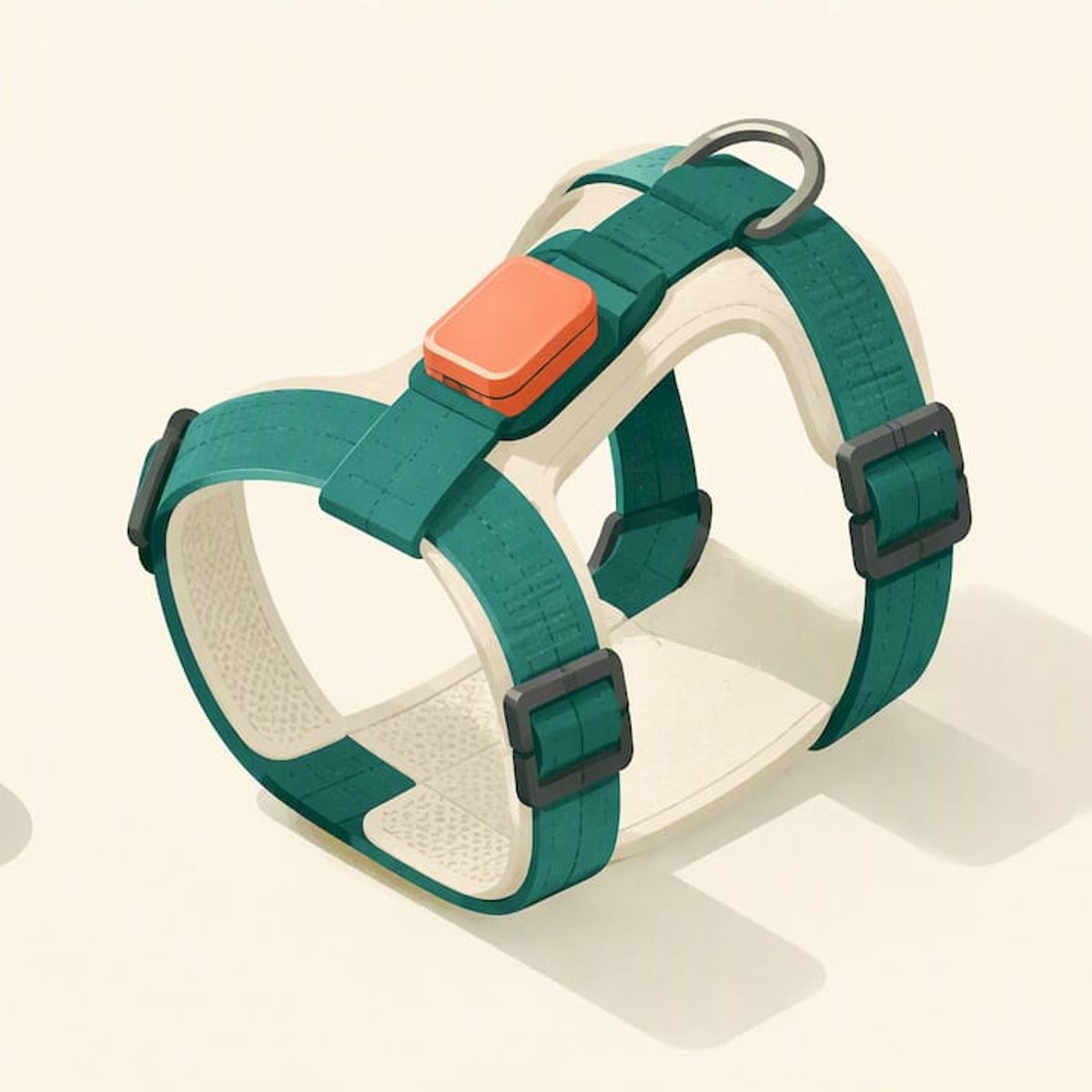
How to Attach a Tracker to a Dog Harness Safely
The safest way to attach a tracker to a harness is to clip or loop it onto a spot that carries no load: a dedicated accessory loop or a low-profile mount sized for the strap, away from the leash D-ring and the center of the chest or back. Then check that the harness still passes the two-finger test and that the tracker doesn’t dangle. The rest of this guide explains each step and the mistakes that cause trouble.
Kinwatchdog
Keep Your Dog’s Location in View
Kin One tracks pets alongside kids and parents on one map, with real-time updates and no ongoing subscription fees.
TL;DR
- Mount the tracker on an accessory loop or a snug, wrap-around mount made for your strap width, never on the leash D-ring or load-bearing webbing.
- Keep it away from the center of the chest and back, where it can get in the way of the leash or of shoulder movement.
- After attaching, slide two fingers under every strap. If you can’t, or the harness sags or shifts, redo the mount.
- A tracker that swings or sticks out can snag on brush. Snug and flat beats bulky and loose.
- Use a real GPS device. Bluetooth tags lose you beyond roughly 30 to 100 feet.
Table of Contents
- Why the attachment point matters more than the tracker
- Choose the harness and the tracker as a pair
- Where to put the tracker on a harness
- Step by step: attaching a tracker to a harness
- Mistakes that cause the most trouble
- Collar or harness: which is better for a tracker?
- Use a GPS tracker, not a Bluetooth tag
- Our perspective: why we think the mount is half the product
- When you shouldn’t attach a tracker at all
- Trackers for cars are a different question
- One device for the dog and the rest of the family
- A quick pre-walk checklist
- FAQ
- Sources
Why the attachment point matters more than the tracker
A tracker is only useful if it is still on your dog when your dog is out of sight. That is the moment you need it, so the mount has to survive running, squeezing under fences, swimming and rolling in the dirt. A tracker that rotates around to dangle under the belly, or one that works the harness loose, does the opposite of what you bought it for.
There are two separate risks to manage. The first is the dog’s comfort and safety: pressure points, chafing, snagging. The second is the harness itself. A harness is built so the load of a pulling dog spreads across the chest. Anything you add that changes that distribution can make it shift, and a harness that loosens can let a dog back out of it.
Veterinary researchers who studied activity monitors on dogs found that, as long as the device is secure, its exact position on the collar did not significantly interfere with data accuracy during routine walks. That is good news for placement: you have some freedom to choose the spot that is best for the dog, rather than the spot that is best for the sensor. The same body of guidance stresses that owners should make sure any attached device doesn’t create a snag risk or interfere with shoulder expansion, which matters most for short-nosed breeds that depend on a well-fitted harness.
Choose the harness and the tracker as a pair
Before you attach anything, look at both pieces.
The harness. A standard harness has one loop around the ribs, one around the neck and a D-ring for the leash, as the American Kennel Club describes it. Look for a spot with some structure: a sewn accessory loop, a flat section of side strap, or a keeper loop. Thin, stretchy mesh and padded neck sections are poor mounting spots because the tracker will pull them out of shape.
The tracker. Weight and thickness decide a lot. A light, flat unit stays put on a side strap. A heavy or tall one tends to flop and tug the strap downward. If you are buying, check how the unit mounts before you check anything else, and ask whether it clips, loops or needs a separate holder.
The dog. A 15-pound terrier and an 80-pound retriever need different solutions. Small dogs have less strap and less tolerance for added weight. Dogs that swim or push through thick cover need a flatter profile and a tighter hold.
Where to put the tracker on a harness
LocationGood forWatch out for
Side strap (flank of the rib loop)
Most dogs; keeps the tracker off the spine and leash point
Can rub in the armpit area if too far back or forward
Accessory loop or keeper loop
Clean, secure hold that doesn’t load the webbing
Only some harnesses have one
Neck strap, off-center
Dogs with deep chests where side straps are crowded
Can swing under the chin if it isn’t snug
Leash D-ring
Nothing: avoid
Wears the hardware, adds load, tangles with the leash
Center of chest or middle of back
Nothing: avoid
Interferes with leash attachment and shoulder expansion
The guidance from veterinary researchers is to prioritize a position that avoids the center of the chest or back. Those are the places where a leash clip, a pulling load or a moving shoulder is most likely to meet the device.
Step by step: attaching a tracker to a harness
- Put the harness on the dog first and adjust it. Fit the harness before adding anything. Adjust it so it sits correctly, then mark the spot you plan to use while the dog stands naturally.
- Run the two-finger test before the tracker goes on. The AKC says a properly fitted harness lets you place two fingers underneath all straps. This is your baseline.
- Take the harness off and attach the tracker on a table. It is far easier to see how the mount sits when the dog isn’t wriggling. Use the mount the device was designed for, or an accessory loop or low-profile wrap-around mount made for your strap width.
- Make it flat and snug. Slide the mount to the side strap or loop and tighten. Nothing should dangle. Tug it: the tracker shouldn’t rotate freely or slide along the strap.
- Put the harness back on and repeat the two-finger test. Check every strap. The tracker’s weight should not concentrate pressure on one point of the coat or skin.
- Watch a short walk. Look for the harness shifting, sagging to one side, or the tracker swinging. Check the skin under the mount for redness after the first few outings.
- Recheck weekly. Straps loosen, fur changes with the season and mounts wear. A thirty-second check beats a lost dog.
Mistakes that cause the most trouble
Zip-tying to the D-ring or the load-bearing strap
It is tempting because it holds. But a tie on the D-ring or a main strap wears the material and can stop the harness from spreading pressure evenly across the chest. Use a purpose-made loop or wrap-around mount instead.
A mount that makes the harness sag
If the harness shifts or sags once the tracker is on, it isn’t secured properly. It can chafe, and a loosened harness can let a dog slip out of it. This is the clearest sign to move the tracker or switch to a lighter unit.
A dangling or bulky tracker
Brush, branches, fences and crate wires all snag swinging objects. If you hike or let your dog work in cover, choose a low-profile mount and tuck or secure any loose strap ends.
Forgetting the harness is the safety device
A tracker can tell you where your dog is. It can’t protect your dog in a crash. The AVMA advises against keeping pets loose in pickup truck beds or vehicles, and says a tracker is no substitute for a crash-tested harness or a crate when you travel. Keep the dog inside the vehicle, restrained properly.
Collar or harness: which is better for a tracker?
Both work. The collar is simpler and doesn’t change how the harness fits, which is why many owners start there. If your dog wears a harness full-time, or slips collars, or pulls hard enough that a collar is uncomfortable, putting the tracker on the harness makes sense, provided the mount follows the rules above. Some owners do both: tracker on the collar, ID tag on the harness, or the reverse.
Harnesses have one real advantage. A dog that backs out of a collar takes the collar and the tracker with it, while a well-fitted harness is harder to escape. The flip side: a harness with a loosened, sagging tracker can fail the same way. Fit decides it, not the type.
Our separate guide on attaching a tracker to a dog collar safely covers the same two-finger check for neck gear.
Use a GPS tracker, not a Bluetooth tag
Attaching the hardware well only helps if the hardware can find your dog. The AKC notes that GPS trackers are recommended for real-time safety, while Bluetooth-based tags are generally ineffective for dogs. They depend on nearby phones and fail beyond a limited range, often 30 to 100 feet, with no true real-time monitoring. The same source suggests that in places without cell coverage you look for a device that stores location history and sends it once a connection returns.
If you want the longer comparison, read 100 to 400 feet vs global GPS and GPS tracker vs AirTag.
Our perspective: why we think the mount is half the product
When we designed Kin One, we started from a plain observation: people judge a tracker by its map, but a dog’s day is decided by the strap. A device that gives perfect locations and slips off the harness is worth nothing, and one that rubs a dog raw gets taken off by the second week.
So we tell families the same thing we’d tell a friend. Pick a flat, quiet spot on the harness. Keep it away from the leash. Do the two-finger check twice, once before the tracker and once after. And don’t ask a device to do the job of a good harness or a seat restraint.
We also built Kin One around a single idea of fairness: you pay once, with no monthly fees, and the same device can go on a dog’s collar, a child’s backpack or a parent’s lanyard, all showing on one map. We deliberately left out audio monitoring and onboard cameras. A tracker should tell you where someone is, nothing more.
For dogs in particular, we’d rather you attach it carefully and check it often than attach it fast and trust it blindly.
— Louis
When you shouldn’t attach a tracker at all
Some situations call for taking the device off.
- Competitive tracking events. AKC tracking tests are strict: no devices are permitted on the dog that provide location, pictures or video. If you compete, leave it in the car or in your pocket, and check with the event’s judge or rules before the run.
- Dogs with respiratory sensitivities. Short-nosed breeds depend on a harness that doesn’t restrict the chest. Any added weight near the shoulders should be minimal, and if in doubt, ask your veterinarian.
- When the harness doesn’t fit. A tracker doesn’t fix a poorly sized harness. Fix the fit first.
Trackers for cars are a different question
Searches for “attach tracker” often drift toward vehicles. That is a separate topic with a separate set of concerns, mainly privacy. Carmakers’ connected apps and infotainment screens often collect precise location and driving data, and the settings are frequently on by default. Consumer Reports explains how to review and limit that sharing. In January 2026 the FTC finalized an order against GM and OnStar over collecting and selling geolocation data without consumers’ informed consent. If your question is about tracking someone else’s vehicle, talk to a lawyer in your state before you act, since the rules vary.
One device for the dog and the rest of the family
If you are choosing a tracker now, think about what you will want in a year. Kin One is a GPS tracker and app that shows kids, pets and parents on one map, with live updates, arrival and departure alerts and up to five approved emergency contacts. It costs $99 one-off, with no monthly fees and a two-year warranty. Privacy controls include route deletion and user-managed visibility.
For dog owners, the details are on our GPS tracker for dogs page. You can also see how the same device works on a collar or lanyard, or what sets a family tracker apart. If you’re weighing the cost, what a tracker subscription is really for is worth a read before you buy anything.
A quick pre-walk checklist
- Harness fits: two fingers under every strap, with the tracker on.
- Tracker sits on a side strap or accessory loop, not the D-ring.
- Nothing dangles, and the tracker doesn’t rotate or slide.
- The harness hasn’t shifted or sagged since you added the device.
- Skin and coat under the mount look normal after the last outing.
- The tracker is charged and showing a live position in the app.
FAQ
Can I attach a GPS tracker to any dog harness?
Most harnesses can carry one if they have a flat strap, a keeper loop or an accessory loop, and the tracker is light enough not to pull the strap out of shape. Very thin, stretchy or heavily padded harnesses are harder. If the harness sags or shifts once the tracker is on, change the spot or the mount.
Is it better to put the tracker on the collar or the harness?
Either works, and veterinary research on activity monitors found that position on the collar made little difference to accuracy. Choose the one that keeps the device snug and out of the way. A collar is simplest. A harness suits dogs that slip collars or pull hard.
Should I zip-tie a tracker to the harness?
We wouldn’t. Zip ties on the D-ring or main straps can wear the material and stop the harness from spreading pressure across the chest. A purpose-made loop or wrap-around mount is safer for the harness and the dog.
Are front-clip harnesses safe with a tracker attached?
They can be, as long as the tracker stays off the front clip and the chest center, so it doesn’t interfere with the leash or shoulder movement. Run the two-finger test and watch a walk. If you have a short-nosed breed or any doubt, ask your veterinarian.
Sources
- American Kennel Club: How to Put on a Dog Harness
- American Kennel Club: Dog GPS Trackers vs Bluetooth Trackers
- American Journal of Veterinary Research: leash attachment and device position on the collar
- AVMA: Pets in Vehicles
- AKC Tracking Judges
- Consumer Reports: Stop Your Car From Collecting and Sharing Your Driving Data
- FTC: Order settling allegations that GM and OnStar collected and sold geolocation data