12,000 Miles of Weak Signal: How Families Can Spot What Blocks GPS
Spot deliberate GPS jamming vs everyday blockage, recognize signs like large outages or sudden time jumps, and handle tracker gaps for families.
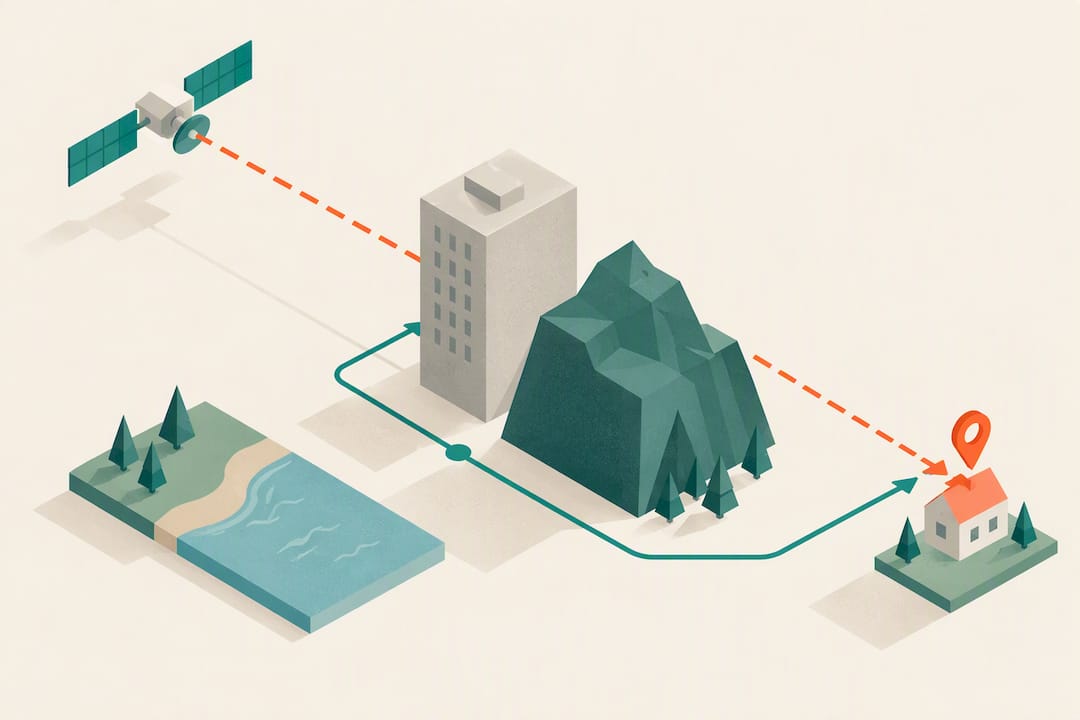
12,000 Miles of Weak Signal: How Families Can Spot What Blocks GPS
GPS is blocked by deliberate jammers and spoofers, by conductive shielding and Faraday enclosures, and by environmental problems like buildings, dense foliage, or being underground. Jamming devices are illegal to sell or operate in most markets and can create real public safety risks. Jamming causes a receiver to lose its fix entirely, while spoofing feeds it a false position that looks valid.
TL;DR:
- GPS jamming devices, such as barrage or protocol-aware jammers, can be effective even at low power because of the faintness of satellite signals, which are around negative 130 dBm at Earth’s surface.
- Structural and environmental obstructions, like metal enclosures, tunnels, urban canyons, and dense foliage, cause temporary signal loss or accuracy degradation, not permanent jamming.
- In the United States, the FCC prohibits the sale, import, and use of GPS jammers, with penalties including fines and device confiscation, as jamming affects broader public safety systems.
- Sudden, area-wide GPS outages affecting multiple devices suggest deliberate jamming, while gradual accuracy drift typically results from atmospheric or terrain-related issues.
- Modern GPS receivers use multi-constellation and adaptive filtering to mitigate interference, but spoofing remains a higher risk because it provides a confident but false fix without detection.
Kinwatchdog
Stay Connected Wherever Family Goes
Kin One puts kids, pets, and parents on one map with real-time updates and no ongoing subscription fees.
Table of Contents
- Types of things that interfere with GPS signals
- How jammers and spoofers actually work
- What everyday materials and environments block GPS
- Is jamming legal, and what are the real risks
- How to tell if your GPS is being jammed, and what to do about it
- Systems-level view: why GPS resilience matters more than one fix
- Most advice on GPS blocking misses the point
- What sets Kin One apart for families worried about tracking gaps
- Sources
- FAQ
Types of things that interfere with GPS signals
GPS interference falls into four rough categories, and telling them apart matters because the fix is different for each one.
Natural and propagation issues come from the physical path between satellite and receiver: atmospheric delay, solar activity, or low satellite geometry. These usually cause gradual accuracy drift rather than a hard loss of signal.
Structural and material blockage happens when something physically absorbs or reflects the signal: concrete floors, metal roofs, parking garages, tunnels. The receiver typically loses lock suddenly and regains it once clear of the obstruction.
Unintentional RF interference comes from other electronics, malfunctioning transmitters, or spurious emissions that happen to land in the GPS frequency band. This tends to be localized and often disappears when a nearby device is switched off.
Intentional jamming and spoofing is a deliberate transmission meant to deny or corrupt a fix. It tends to appear suddenly, affect a wide area rather than one device, and persist regardless of location changes.
- Intermittent, location-linked dropouts usually point to structural blockage.
- Sudden, area-wide outages affecting multiple devices at once suggest deliberate jamming.
- Gradual accuracy decline with a maintained fix usually reflects atmospheric or geometric effects.
How jammers and spoofers actually work
Jamming and spoofing solve different problems for whoever is doing the interfering. A jammer floods the GPS frequency band with noise or a competing signal strong enough to bury the real satellite transmissions, so the receiver simply cannot decode anything. Spoofing is subtler: it broadcasts fake GNSS-like signals that mimic real satellites closely enough that a receiver locks onto them and reports a location or time that is wrong but never flagged as invalid, a distinction the FAA’s interference resource guide lays out in detail.
Jammers themselves vary in sophistication:
- Barrage jammers blast wideband noise across the entire GPS frequency range, brute force but effective at close range.
- CW or tone jammers target a narrow frequency with a continuous wave, cheap to build but easy for a receiver to filter out.
- Chirp jammers sweep rapidly across frequencies, making them harder to notch out with a simple filter.
- Protocol-aware jammers are built with knowledge of GNSS signal structure, letting them disrupt specific channels more efficiently than blunt noise.
Even a low-power jammer can be effective. GPS signals arriving at Earth’s surface are extraordinarily weak, on the order of negative 130 dBm, according to technical analysis of GNSS interference. That faintness is why a small, cheap transmitter can drown out a satellite signal that traveled over 12,000 miles.
What everyday materials and environments block GPS
Some blockage is intentional design, some is just physics. Here is what actually stops a signal, roughly in order of how completely it does so.
- Faraday bags and metal enclosures. A properly constructed Faraday bag or metal box blocks radio frequencies almost entirely, which is why they show up in anti-tracking discussions; a tracker sealed inside one will typically go dark within seconds.
- Aluminum foil wraps. Foil offers inconsistent shielding depending on thickness and how completely it wraps the device, so it can degrade a signal without fully killing it.
- Vehicle trunks and metal cargo holds. Placing a tracker inside a metal enclosure inside a vehicle compounds attenuation, often pushing a marginal signal to no signal at all.
- Underground and tunnel environments. Signals cannot penetrate rock or thick concrete, so devices lose their fix completely until they resurface.
- Urban canyons and indoor spaces. Tall buildings and multiple walls cause multipath and heavy attenuation rather than a hard block, and Gps that accuracy which is generally good under open sky degrades considerably in these settings.
- Dense forest canopy. Thick, high-density tree cover scatters and absorbs signal more than sparse foliage does, sometimes enough to trigger a device’s last-known-position fallback.
Is jamming legal, and what are the real risks
Jamming is not a gray area. In the United States, the FCC prohibits the operation, marketing, sale, and import of GPS jamming devices outright, and enforcement includes fines, equipment seizure, and in some cases criminal referral.
- The FCC has stated it maintains a zero tolerance policy toward jammer sales and use.
- Penalties can run into thousands of dollars per violation, alongside confiscation of the device itself.
- A separate FCC enforcement advisory reinforces that even personal use, not just commercial sale, carries legal exposure.
Jamming does not stay contained to one device. A jammer meant to defeat a single tracker can knock out GPS for everyone nearby, including 9-1-1 dispatch systems, first responder communications, and, per the FAA, aircraft navigation and timing systems that depend on the same signals. That ripple effect is the core reason regulators treat jamming as a public safety issue rather than a private nuisance. If you suspect intentional interference near you, the right move is reporting it to the FCC, not attempting to counter it yourself.
How to tell if your GPS is being jammed, and what to do about it
Most GPS problems are mundane. But a handful of signs point toward deliberate interference rather than an obstructed antenna.
- Sudden, simultaneous loss of multiple satellites rather than a gradual drop indicates possible deliberate interference.
- Unusually low signal-to-noise ratio readings on devices that expose that data.
- Position or time jumps that do not match the receiver’s actual movement.
- Sensor disagreement, where GPS location conflicts sharply with accelerometer or compass data.
Modern receivers push back against interference with a few design choices. Multi-constellation, multi-frequency receivers can cross-check GPS against other GNSS systems like Galileo or GLONASS, making a single jammer less decisive. Adaptive notch filters and pulse blanking, described in industry material from receiver manufacturers like Septentrio, strip out narrowband interference before it reaches the tracking loop. None of these fully defeats a chirp or protocol-aware jammer on its own, which is why layered defenses matter more than any single feature.
When GPS does drop, the practical fallback path matters. Inertial measurement (using motion sensors to estimate position when satellites are unavailable), cellular or Wi-Fi positioning, and dead-reckoning all buy time until a clean fix returns. Consumer devices should default to reporting a last-known position with a timestamp rather than silently failing.
For everyday troubleshooting: move to open sky away from tall buildings or dense cover, check that the antenna and firmware are current, and if a low-cost receiver keeps losing lock in conditions where better hardware does not, that is often the receiver, not the environment.
Pro Tip: If a tracker loses signal only in one specific spot every time, it is almost always a structural block, not interference. Test the same device in an open field before assuming anything deliberate is happening.
Systems-level view: why GPS resilience matters more than one fix
Aviation offers the clearest picture of why GPS interference is treated as a systems problem rather than a single-sensor glitch. The FAA’s interference resource guide catalogs how a jammed or spoofed signal can cascade into other avionics: timing systems, terrain awareness, and ADS-B position reporting can all inherit an error that started with the GNSS receiver.
Spoofing is the harder problem. A jammed receiver at least knows it has lost its fix. A spoofed receiver reports a confident, wrong answer, and because civilian GNSS signals are unauthenticated, there is no built-in way for the receiver to know the difference. That is what makes spoofing quietly more dangerous than jamming in aviation and maritime contexts.
The resilience advice that follows from this is consistent across the guidance: no single mitigation defends against every jammer type, so detection, alternate positioning sources, and reporting suspicious interference to regulators all need to work together rather than relying on any one fix to restore a signal.
Most advice on GPS blocking misses the point
The conventional advice on this topic treats jamming as the headline threat and spoofing as a footnote, which reverses the actual risk. Jamming is loud, obvious, and mostly self-limiting: your device tells you it lost a fix. Spoofing hands you a wrong answer with total confidence, which is far more dangerous for anyone actually depending on that location, whether that is a pilot, a delivery fleet, or a parent checking on a child’s tracker.
The other thing overrated in most consumer guidance is troubleshooting order. People jump straight to blaming interference when the far more common cause is mundane: a parking garage, a backpack, thick tree cover. Before assuming anything deliberate, rule out the boring explanations first.
If there is one thing worth prioritizing, it is understanding what your specific device does when it loses a clean fix. A device that silently reports a stale location as current is far riskier than one that flags uncertainty and falls back to a last-known-position alert with a timestamp.
— Louis
What sets Kin One apart for families worried about tracking gaps
Most of what blocks GPS, tunnels, parking garages, dense tree cover, is temporary and resolves itself once the device clears the obstruction. The real question for a family tracker is what happens during that gap and what it costs you long term. Kin One is built as a one-time purchase with no monthly fees and lifetime data, so a signal dropout in a garage or under heavy canopy does not come with a recurring subscription bill attached regardless of how often it happens.
Kin One keeps kids, pets, and parents on a single map with live updates and arrival and departure alerts, plus up to five approved emergency contacts and privacy controls that let you delete routes and manage who sees what. There is no audio monitoring or onboard camera, just real-time hardware GPS without the extra layers some tracking services bundle in. If the everyday reality of GPS blind spots is what brought you here, you can check out Kin One and see whether a single upfront cost fits your family better than another monthly plan.
Sources
- Jammer enforcement | FCC
- GPS and GNSS Interference Resource Guide | FAA
- NSF-funded analysis of RFI impact on GNSS
FAQ
Is a GPS jammer illegal to own or use?
Yes, in most jurisdictions including the United States, where the FCC prohibits the sale, import, marketing, and operation of GPS jamming devices, with enforcement that includes fines and equipment seizure. Personal use carries the same legal exposure as commercial sale.
What household materials can block a GPS signal?
Faraday bags and sealed metal enclosures block GPS almost completely, while aluminum foil gives inconsistent results depending on thickness and coverage. Thick concrete, tunnels, and parking garages also block signals structurally rather than through shielding.
Will a magnet disable a GPS tracker?
A standard magnet does not interfere with GPS signal reception, since GPS relies on radio frequency signals rather than magnetic fields. A magnet could disrupt a device’s internal electronics only if strong enough to affect components directly, but this is not a reliable or common way trackers are disabled.
What can disrupt GPS besides deliberate jamming?
Environmental factors like urban canyons, dense tree canopy, and indoor use commonly degrade GPS accuracy without any deliberate interference. Unintentional radio frequency emissions from other electronics can also land in the GPS band and cause localized disruption.
What signs suggest GPS jamming rather than normal signal loss?
Jamming typically causes a sudden, area-wide loss of satellites affecting multiple devices at once, rather than a gradual or single-device dropout. Low signal-to-noise readings and position or time jumps that do not match actual movement are also common indicators described in research on GNSS interference.